
These are the notes of the nycklelharpa. I read treble clef.

The open string double stops work like this:
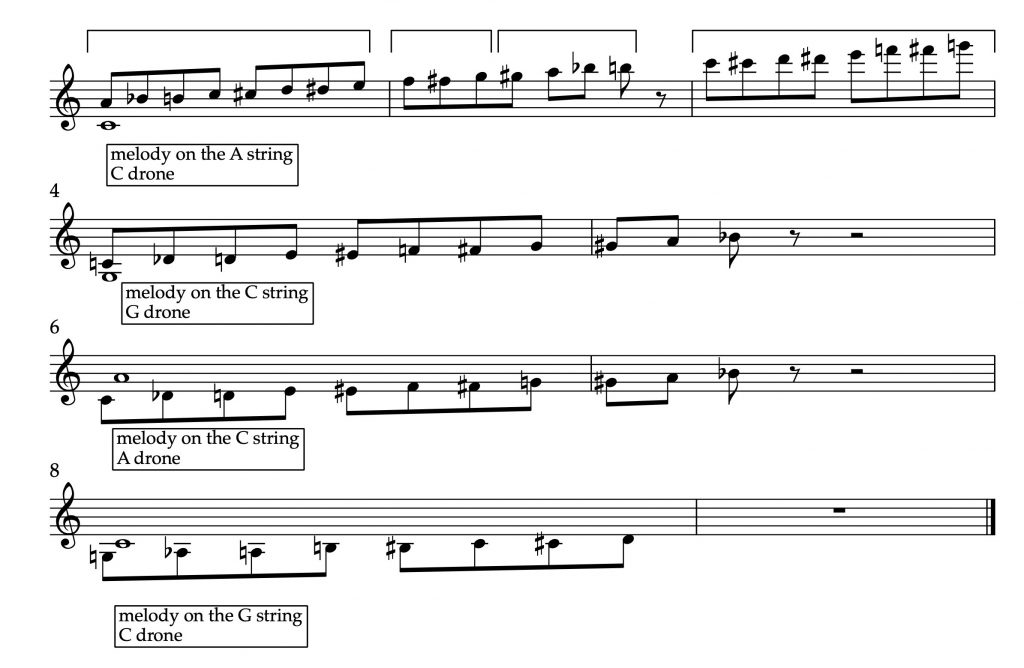
Note: I need to update the image below – I have a nyckelharpa that is chromatic all the way to the top – but generally choose to use the other instrument.

I also own a violin tuned Nyckelharpa. I use this for sounding more like a country-style fiddler.

I do know what is at the top of the violin-pitched nyckelharpa. 🙂
The video called Ceilidh with Capability shows what I mean.
Some handy things to keep in mind:
Spiccato is a challenge. The nyckelharpa in a Swedish folk context is usually played very legato and the bow is shaped to accommodate that. However I try really hard to play as spiccato as I can. (Current record is repeated semi-quavers at bpm crotchet = 162, not comfy, but it’s doable).
Jumps because the top string is only an A we jump a lot. Jumping takes time.
Key noise – it’s keyed, we have key return noise.
Double Stops – not everything is possible because we don’t have all the notes on all the strings.
D tuning and C tuning – it’s not a drone, or transposing instrument thing. It’s just where the open string is. If it’s playable on a D tuned harpa, it’s played on a C tuned harpa. It’s just one string is tuned differently. So it only affects the double stops and drone notes. (On the whole I don’t retune – if I need a D string I’ll use the fiddle pitched harpa)
Trio – 2 normal nyckelharpa and 1 oktavharpa (cello pitch)